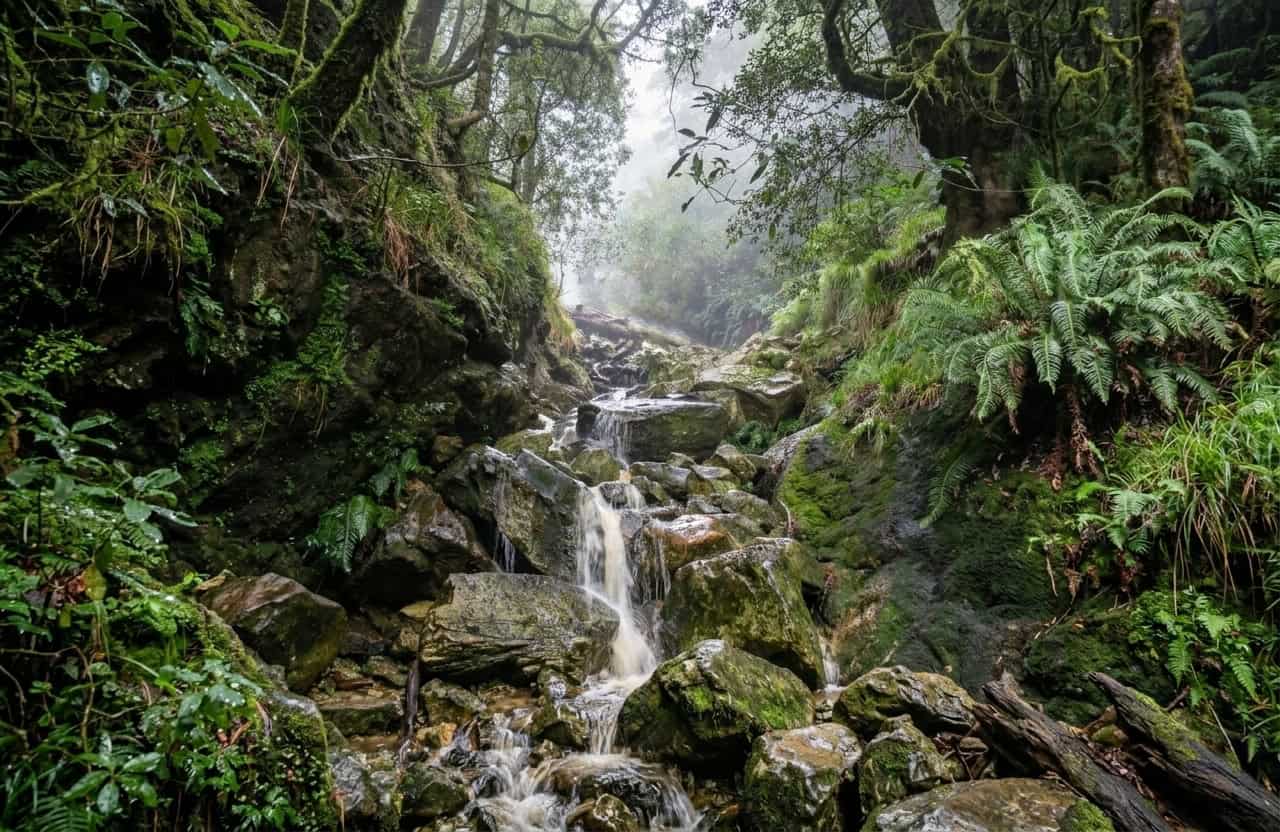
If you’ve spent any time in Cape Town, you know that the city’s relationship with its mountain is… complicated. We look at it to find our bearings, we check its “tablecloth” of clouds to predict the wind, and we argue incessantly about which route to the top is the superior one. For some, it’s the direct, thigh-burning stairmaster of Platteklip Gorge. For others, it’s the terrifyingly exposed scrambles of India Venster. But if you ask a local where they go when they want to actually experience the mountain’s soul, they will point you toward the lush, emerald canopy of the Skeleton Gorge Hiking Trail.
The “Cape Doctor”—our legendary South Eastern wind—is doing its best to blow the hats off tourists at the Waterfront. Up in the gorge, however, it’s a different world. The air is cool, the water is trickling over ancient rocks, and the sun is filtered through a thick screen of Afromontane forest. Skeleton Gorge is Table Mountain’s “back door,” a route that takes you from the manicured lawns of Kirstenbosch through a prehistoric jungle and onto a white-sand beach located 700 meters above sea level.
Sound like a fever dream? It isn’t. But it is a serious hike. If you’re planning to tackle the gorge this season, you need to know more than just “follow the path.” Here is everything I’ve learned from years of sweat, wrong turns, and summit sunrises on the most dramatic route in the Cape.
1. The Starting Line: Kirstenbosch National Botanical Garden
Your journey begins at what is arguably the most beautiful garden in the world. To access Skeleton Gorge, you first have to enter Kirstenbosch National Botanical Garden. The garden remains the primary guardian of the trail, and yes, you do have to pay the entrance fee (roughly R220 for international visitors and R100 for South African residents with ID).
Where to Park and Enter
I always recommend parking at the Top Gate (Gate 2). It’s located higher up the slopes of Kirstenbosch, saving you a good ten minutes of uphill walking before the “real” hike even starts. From here, follow the signs for the “Smuts Track” or “Skeleton Gorge.” You’ll wind past the fragrance gardens and the famous Boomslang Canopy Walkway, which is worth a quick detour if you’ve arrived early.
Key Takeaway: Don’t rush through the gardens. The transition from the curated flower beds to the wild, tangled forest of the gorge is one of the best parts of the hike.
2. The Jungle Phase: Into the Canopy
Once you step off the gravel paths of Kirstenbosch and into the forest proper, the temperature drops significantly. This is the Afromontane forest, a remnant of a much wetter era in Africa’s history. You are surrounded by Yellowwoods, Cape Beech, and ancient ferns.
The Terrain
The first third of the hike is all about the “steps.” The trail builders have done an incredible job with stone masonry, but make no mistake: this is a vertical climb. It’s steep, damp, and occasionally slippery.
- The Stream: For much of the ascent, you’ll be hiking alongside (or directly in) a mountain stream. In March, it might be a mere trickle, but the rocks remain mossy.
- The Ladders: About halfway up the gorge, you’ll encounter a series of wooden ladders. Don’t worry—they are bolted securely into the rock. They aren’t particularly high, but they do require a bit of focus and three points of contact. If you have a severe fear of heights, this is the “crux” of the route, but most people find them more fun than frightening.
Key Takeaway: Take frequent breaks to look up. The way the light filters through the indigenous canopy is enough to make even the most cynical hiker feel like they’re in a Ghibli movie.
3. The Summit Surprise: The Beach on the Mountain
After about 60 to 90 minutes of climbing (depending on how many photos you stopped to take of the frogs), the forest abruptly thins. You’ll find yourself at the top of the gorge, often standing above the cloud line.
Instead of a rocky plateau, you are greeted by something entirely unexpected: the Hely-Hutchinson Reservoir. Because of the white quartz sand found on the mountain, the shores of this reservoir look exactly like a tropical beach.
- The Vibe: It is one of the most serene spots in the city. On a windless day, the water is a perfect mirror for the sky.
- The History: You’ll see the old steam engine tracks that were used to build the dams in the late 1800s. It’s a strange, industrial ghost story sitting at 700 meters.
- Key Takeaway: This is the best place for your main snack break. Take your boots off, feel the sand between your toes, and realize you’re on top of one of the world’s New Seven Wonders of Nature.
4. The Final Push: Reaching Maclear’s Beacon
For many, the reservoir is the destination. But if you’ve come this far, you might as well bag the summit. From the reservoir, follow the signs toward Maclear’s Beacon.
This part of the hike is a “flat” traverse across the Back Table, but “flat” is a relative term on Table Mountain. You’ll be navigating a boardwalk that protects the sensitive fynbos. This is where you’ll see the famous Proteas and Restios that make the Cape Floral Kingdom so unique.
Maclear’s Beacon is the highest point on the mountain, marked by a massive stone cairn built by Sir Thomas Maclear in 1844 for a trigonometric survey. It stands at 1086 meters above sea level. From here, you have a 360-degree view that includes False Bay, the Hottentots Holland Mountains, and the endless Atlantic.
Key Takeaway: The weather can change in seconds here. Even if it was 30°C in Kirstenbosch, the summit can be shrouded in a cold, damp mist (the “Tablecloth”) within minutes. Always carry a windbreaker.
5. The Descent: Choosing Your Adventure
The golden rule of hiking Skeleton Gorge is this: Never hike down Skeleton Gorge. The same damp rocks and ladders that were fun on the way up become treacherous on the way down. Most hikers choose one of two options for their descent:
- Nursery Ravine: This trail starts near the top of Skeleton Gorge and takes you back down into Kirstenbosch. It’s steep and involves a lot of stone steps, but it’s significantly safer for your knees and ankles than the gorge itself.
- The Cableway: If you’re feeling spent, you can continue your walk from Maclear’s Beacon to the Upper Cable Station. It’s about a 45-minute walk from the beacon. You can then take the Table Mountain Aerial Cableway down and catch an Uber back to your car at Kirstenbosch.
Pro-Tip: Check the Cableway’s official website before you commit to this plan. If the wind is too high, the cableway shuts down, and you’ll be forced to walk down Platteklip Gorge (which is a long way from your car!).
6. Essential Survival Tips
Hiking in Cape Town isn’t like hiking in Europe or North America. Our mountains are rugged, our sun is fierce, and the weather is temperamental.
- Water is Life: There are no taps in the gorge. Carry at least 2 liters of water per person. While the stream water looks clean, it’s best to use a filter if you’re planning to drink it.
- The “Safety in Numbers” Rule: Never hike alone. Skeleton Gorge is a popular trail, but it’s easy to twist an ankle on the ladders. I highly recommend downloading the Hikers Network safety app or joining the “Table Mountain Watch” groups.
- Timing: Start early. In March, the sun hits the eastern slopes of the mountain by 8:00 AM. If you start at 7:00 AM, you’ll be in the shade of the gorge for the entire ascent.
- Footwear: Leave the sneakers at home. You need shoes with serious grip. The moss-covered rocks in the gorge have no mercy for smooth soles.
- Connectivity: Signal is patchy in the gorge but generally good on the summit. Keep your phone charged, but don’t rely on it for navigation—download an offline map like AllTrails or Gaia GPS.
Bold Takeaway: Respect the mountain. Every year, experienced hikers get caught out by the “Tablecloth” or a sudden drop in temperature. If the clouds roll in and you lose the path, stay put and call for help.
The Verdict: Is Skeleton Gorge Worth the Burn?
Let’s be honest: your quads are going to scream for the next two days. You will probably slip once, you will definitely sweat through your shirt, and you might question your life choices while standing on the third rung of a wooden ladder in a damp forest.
But then you’ll reach the top. You’ll see that white sand beach reflecting the African sun, you’ll smell the fynbos, and you’ll realize that you’ve just experienced a side of Cape Town that 95% of visitors never see. Skeleton Gorge isn’t just a hike; it’s a rite of passage for anyone who wants to call themselves a true “Capetonian.”
It’s the perfect blend of botanical beauty, physical challenge, and geographical weirdness. So, pack your bags, lace up your boots, and go get acquainted with the green heart of the Mother City.