There is a very specific kind of itch that starts somewhere around Thursday afternoon in Cape Town. It’s that restless feeling that the shadow of Table Mountain, as magnificent as it is, is starting to feel a little too familiar. You start glancing at the clock, wondering if you can beat the N1 outbound traffic, and mentally packing a bag with nothing but a swimsuit, a thick novel, and a pair of hiking boots.
The beauty of living in the Mother City isn’t just the city itself; it’s the fact that within a 120-minute radius, you can find yourself in a completely different world. You could be sipping olive-oil infused gin in a quirky Swartland village, watching flamingos dance in a turquoise lagoon, or waking up to the sound of wild horses trotting past your bedroom window in the Overberg. We are incredibly spoiled for choice, but sometimes the “where should we go?” debate takes longer than the actual drive.
I’ve done the Friday afternoon dash more times than I care to admit, and I’ve learned that the “Goldilocks Zone”—that perfect distance where you feel far enough to escape but close enough to avoid a road-trip tantrum—lies exactly two hours away. If you’re looking to trade the city hum for something a bit more soulful, here are the escapes that never fail to reset the system.
The Olive Scented Charm of Riebeek Kasteel
If you head north-east for about an hour and fifteen minutes, the landscape shifts from suburban sprawl into the rolling, golden wheat fields of the Swartland. At the foot of the Kasteelberg Mountain lies Riebeek Kasteel. This isn’t your typical polished wine town; it’s a bit more bohemian, a bit more rugged, and a lot more relaxed.
What I love about Riebeek is that it feels like an artist’s retreat. The town square is lined with massive fig trees and eccentric galleries. It’s the kind of place where you can spend an entire morning just sitting on the “stoep” of the Royal Hotel, which claims to have the longest colonial porch in the Southern Hemisphere. It’s a bold claim, but once you’re there with a gin and tonic in hand, you really won’t care to verify the measurements.
- The Local Flavor: This is olive country. You absolutely have to stop at the Riebeek Valley Wine Co to sample the local harvest.
- The Hike: For those who need to move, the trails up Kasteelberg Mountain offer views that stretch all the way to Table Mountain on a clear day.
- The Vibe: It’s quiet. If you’re looking for a thumping nightlife, this isn’t it. If you’re looking for long lunches that bleed into dinner, you’ve found paradise.
Key Takeaway: Riebeek Kasteel is the ultimate destination for the creative soul looking for slow living, Mediterranean vibes, and the best olives in the country.
Turquoise Waters and Salt Air in Langebaan
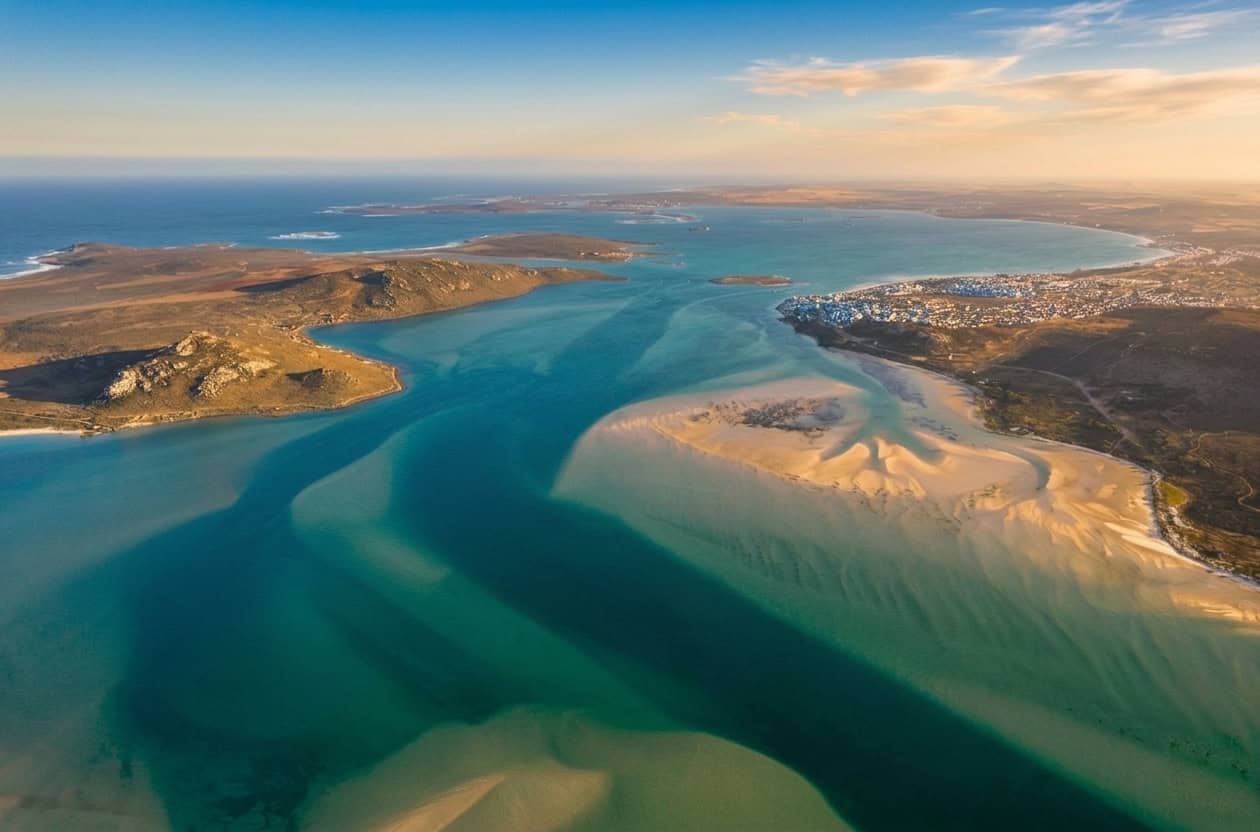
Sometimes, you just need to see the ocean, but not the freezing, moody Atlantic of the Atlantic Seaboard. About 90 minutes up the West Coast road, you hit Langebaan. It’s often dismissed as a “kitesurfing town,” and while the wind-warriors certainly love it, there is a much softer side to this lagoon-side escape.
The West Coast National Park is the real star here. Inside the park, you’ll find Kraalbaai, where the water is so blue and still it looks like it belongs in the Caribbean. I’ve spent many Saturdays just floating in that knee-deep water, marveling at how a place this serene can exist so close to a major city.
- Feasting on the Beach: You can’t go to the West Coast and not eat at Die Strandloper. It’s an open-air seafood feast where you eat with your hands and use mussel shells as spoons. It is messy, glorious, and utterly unpretentious.
- Bird Watching: Even if you aren’t a “birder,” the flamingos and pelicans in the Langebaan Lagoon are a sight to behold.
- The Lagoon Life: If you’re feeling active, rent a kayak or a stand-up paddleboard. The lack of waves makes it a very forgiving place to learn.
Key Takeaway: Langebaan and the surrounding park offer a bright, coastal energy that feels like a summer holiday no matter what the calendar says.
Old World Romance and Mountain Mists in Greyton
To get to Greyton, you head over Sir Lowry’s Pass and into the Overberg. By the time you reach the town—roughly an hour and forty-five minutes from the CBD—you’ll notice that the paved roads have given way to gravel and the speed limit is essentially “whatever the horses are doing.”
Greyton is the quintessential country village. It’s tucked into a fold of the Riviersonderend Mountains, and it has an almost European feel with its thatched cottages and rose-lined lanes. There are no streetlights here, which means the stargazing is world-class. If you’re looking for a romantic reset, this is the one.
- The Saturday Market: It is a local institution. Get there early for the homemade lemon curd and the pancakes.
- The Post House: If you’re looking for a historical stay, The Post House is a beautifully restored landmark that used to be—you guessed it—the village post office.
- Nature Walks: The Greyton Nature Reserve has some of the best fynbos hiking trails in the province. The “Gifkloof” trail is particularly beautiful after a bit of rain.
Key Takeaway: Greyton is a time capsule. It’s the perfect place to switch off your phone, put on a thick sweater, and reconnect with someone special.
The Culinary Heavyweight of Franschhoek
Yes, everyone knows Franschhoek. But there is a reason this valley remains one of the top weekend destinations in the world. About an hour’s drive from Cape Town, it’s the most “manicured” of our getaways. It’s where you go when you want the best of everything: the best food, the best wine, and the most luxurious linens.
While most people focus on the main road, I find the real magic is slightly further up the pass. The views from the top of the Franschhoek Pass are breathtaking, especially at sunrise when the mist still clings to the valley floor.
- The Wine Tram: If you want to sample the valley’s famous estates without worrying about the drive, the Franschhoek Wine Tram is a brilliantly fun way to do it. It’s iconic for a reason.
- The Art of Wine: Visit La Motte for a dose of culture alongside your Sauvignon Blanc. Their gallery and museum are world-class.
- Mountain Exploration: Don’t skip the Mont Rochelle Nature Reserve. It offers a rugged contrast to the polished town below.
Key Takeaway: Franschhoek is the place for high-end indulgence. It’s sophisticated, delicious, and consistently delivers a world-class experience.
White-Washed Dreams in Paternoster
Pushing the two-hour limit just slightly (depending on how heavy your foot is), Paternoster is the oldest fishing village on the West Coast. It’s famous for its strict building codes, which mean every house is white with blue accents. It looks like a Greek island that accidentally landed in the South African fynbos.
There is a wildness to Paternoster into which you don’t find elsewhere. The wind can be fierce, the sea is freezing, and the sun is bright. But there is also a deep, quiet peace here. It’s a place for long walks on the sand and eating your weight in crayfish.
- Gourmet Excellence: If you can snag a booking, Gaaitjie offers a “salt-of-the-earth” fine dining experience right on the rocks.
- The Lighthouse: A walk to the Cape Columbine Lighthouse is essential. It’s the last manually controlled lighthouse in South Africa and the views from the reserve are spectacular.
- The Kayak: Seeing the village from the water is a completely different experience. Keep an eye out for dolphins!
Key Takeaway: Paternoster is for those who find beauty in the rugged and the raw. It’s a place to clear your head and fill your lungs with salt air.
Making the Most of Your Short Escape
Before you hit the road, there are a few practical things to keep in mind to ensure your 48-hour escape doesn’t turn into a logistical nightmare.
- The Traffic Factor: If you leave the CBD at 4:30 PM on a Friday, your two-hour drive will become three. If you can, aim to leave by 2:00 PM or wait until after 6:30 PM.
- Check the Wind: The Cape is famous for its wind. If you’re heading to Langebaan or Paternoster, check the forecast. A “Black South-Easter” can make a beach weekend quite challenging.
- Book Ahead: Because these spots are so close to the city, they fill up fast, especially on pay-day weekends or during school holidays. Always check the official websites of places like The Post House or Franschhoek Wine Tram well in advance.
- Support Local: These small towns rely on weekend visitors. Buy your supplies from the local butcher in Greyton or the olive shop in Riebeek rather than stocking up at a big supermarket in the city. It tastes better and it helps the community.
Why We Keep Heading Back to the Road
We live in a city that people save their whole lives to visit, yet the urge to leave is something every local understands. It’s the contrast that makes Cape Town so livable. Knowing that you can finish a meeting at 4:00 PM and be watching the sun set over a West Coast lagoon by 6:00 PM is a privilege we shouldn’t take for granted.
Whether you choose the artistic lanes of Riebeek Kasteel, the blue waters of Langebaan, or the mountain silence of Greyton, the goal is the same: to return on Sunday afternoon feeling like the world is a little bit bigger and your stress is a little bit smaller. The Mother City will always be there to welcome you back, but sometimes, the best way to love Cape Town is to leave it for a while.