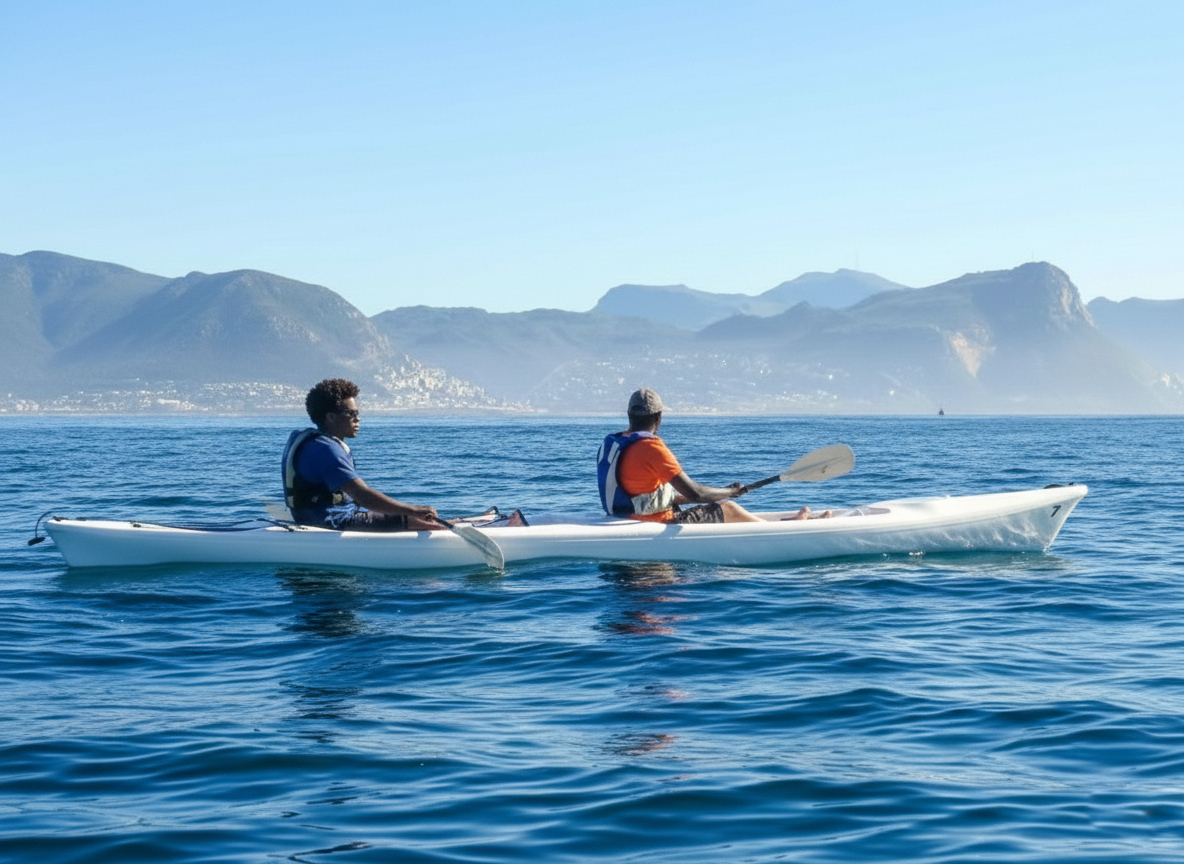
There’s a specific kind of magic that happens when you’re sitting just a few inches above the waterline in a plastic cockpit, the Atlantic Ocean is humming beneath you, and a flightless bird torpedoes past your paddle at twenty kilometers per hour. If you’ve ever stood on the crowded boardwalks of Boulders Beach, peering over a wooden railing at the tuxedoed residents below, you’ve seen the penguins. But until you’ve shared their medium—the cold, nutrient-rich swell of False Bay—you haven’t truly met them.
The experience of kayaking with penguins in Simon’s Town has evolved. It’s no longer just a “tourist box” to tick; it’s become one of the city’s most vital eco-tourism touchpoints. With the African Penguin facing increasingly steep conservation challenges this year, getting out on the water offers a perspective that is both humbling and exhilarating.
So, if you’re ready to trade the boardwalk crowds for a salty face and a bit of a shoulder workout, here is everything you need to know about paddling with the “Jackass” penguins of the South Peninsula.
Why the Waterline Changes Everything
Most visitors to Simon’s Town head straight for the Boulders Visitor Centre. Don’t get me wrong, the boardwalks are great for a close-up photo of a nesting pair, but it feels a bit like watching a movie from the lobby.
When you launch a kayak from Seaforth Beach, you’re entering their world on their terms. In the water, the African Penguin transforms from a clumsy, waddling comedian into a sleek, aerodynamic hunter. Seeing them “porpoising”—leaping out of the water to breathe while maintaining high speed—right next to your boat is a sight that never gets old.
The focus of these tours has shifted heavily toward “silent observation.” The kayaks used are high-stability, sit-on-top models that allow you to glide over the kelp forests with minimal disturbance. There is no engine noise, no smell of diesel—just the sound of your paddle dipping into the water and the occasional braying of a penguin (which, for the uninitiated, sounds exactly like a disgruntled donkey).
The Best Operators to Get You Out There
Two main operators dominate the scene, both of which have survived the recent shifts in tourism by doubling down on sustainability and local guide expertise.
1. Shark Warrior Adventures
Based right at Seaforth Beach, Shark Warrior Adventures is more than just a rental shop; they are a conservation-centric outfit. Their tours are led by guides who are often involved in local marine biology projects.
- The Route: They launch from Seaforth and head straight toward the Boulders colony. It’s a shorter paddle to get to the “action,” making it ideal for beginners or those who might be a bit nervous about the False Bay swell.
2. Kayak Cape Town
Operating out of the Simon’s Town Waterfront, Kayak Cape Town offers a slightly longer “journey” feel. You’ll paddle past the South African Naval base, which provides a fascinating juxtaposition of massive steel warships and tiny, fragile marine life.
- The Highlight: They often stop at a “secret” beach only accessible by water, where you can hop out, stretch your legs, and perhaps take a quick (and very chilly) dip with any curious penguins nearby.
The Paddle Route: What You’ll See
A typical morning paddle in February usually starts around 08:30 or 09:00 AM. Why so early? Because in Cape Town, the “South Easter” wind is a formidable opponent. By midday, the wind often picks up, making the return journey a grueling slog.
The Kelp Forests of Seaforth
As you move away from the shoreline of Seaforth Beach, you’ll glide over massive swaying bamboo kelp. These forests are recognized as one of the most productive ecosystems on Earth. Keep your eyes peeled—it’s not just penguins down there. You’ll often see Cape Fur Seals darting through the stalks, and if you’re lucky, the shy Puffadder Shyshark might be visible in the clearer patches of sand.
The Roman Rock Lighthouse
If the conditions are calm, many guides will take you further out toward Roman Rock Lighthouse. It is the only lighthouse in South Africa built on a single rock in the middle of the ocean. It remains a stark, beautiful sentinel against the horizon. While the penguins don’t usually venture this far out in large numbers, the view of the Peninsula from this vantage point is worth every drop of sweat.
Boulders and Foxy Beach
The climax of the trip is, of course, the penguin colony. As you approach Boulders Beach from the sea, the massive granite rocks provide a natural amphitheater.
- The Interaction: Penguins are naturally curious. The “Golden Rule” is strictly enforced: Do not approach within 5 meters. However, nobody told the penguins that. It’s not uncommon for a penguin to swim right up to your kayak to inspect its reflection in the plastic. Sit still, keep your paddle out of the water, and just enjoy the moment.
- The Sounds: The sheer volume of the colony is surprising. From the water, the braying echoes off the rocks, creating a wall of sound that is strangely prehistoric.
Penguin Etiquette and the Conservation Reality
It’s important to address the elephant (or penguin) in the room. As of early 2026, the African Penguin is officially classified as Critically Endangered. Biologists estimate that at the current rate of decline, the wild population could be functionally extinct by 2035.
Because of this, the kayaking community in Simon’s Town has taken on a “Guardianship” role. Bold takeaway: Your tour isn’t just a fun day out; it’s a contribution to the local economy that proves these birds are worth more alive and protected than any alternative.
- No Touching: It should go without saying, but never try to touch a penguin. Their feathers have a delicate waterproof coating that is easily damaged by human oils. Plus, they have incredibly sharp beaks and a mean “pinch.”
- Plastic Patrol: Most guides carry a “trash mesh” on the back of their kayaks. If you see a piece of floating plastic or an old fishing line, pick it up. It’s a small gesture, but it saves lives.
- Sunscreen Choice: Please use Reef-Safe Sunscreen. Even though you aren’t directly in the water for long, the chemicals in standard sunscreens are toxic to the delicate marine life in the kelp forests.
Post-Paddle Recovery: Simon’s Town’s Best Bites
After two hours on the water, you’re going to be salt-crusted and starving. Simon’s Town has a thriving food scene that has moved well beyond standard fish and chips.
- For the Caffeine Hit: Head to Salty Sea Dog for a classic, no-frills experience, or for something more artisanal, check out The Sweetest Thing on St George’s Street. Their pastries are legendary in the South Peninsula.
- The “I Deserve This” Lunch: Lighthouse Cafe offers a coastal-chic vibe with incredible seafood pasta and fresh mussels. It’s the perfect place to scroll through your penguin photos and let your arms recover.
- The Local Legend: If you want the best fish and chips in the Cape, Salty Sea Dog at the harbor remains the undisputed champ. Eat your calamari on the pier while watching the boats come in.
What to Bring (and What to Leave Behind)
Packing for a kayak trip is an art form. You want to be prepared, but you don’t want to lose your gear to the “Atlantic Tax” if you happen to flip.
- Wear: A swimsuit or quick-dry gym gear. Avoid denim at all costs—once it’s wet, it stays wet and heavy. A windbreaker is a good idea even on a hot day, as the breeze off the water can be chilly.
- Bring: A hat with a chin strap. High-SPF sunscreen (reef-safe!) and a bottle of water.
- Leave: Your non-waterproof watch, your car keys (give them to the tour operator to put in their safe), and your ego.
A Quick Note on “Sea Sickness”
False Bay is generally calmer than the Atlantic Seaboard, but it’s still the ocean. If you’re prone to motion sickness, take a ginger tablet or a motion-sickness pill about 30 minutes before you launch. There’s nothing that ruins a penguin encounter quite like feeling green around the gills.
For the Adventurer
Kayaking with penguins in Simon’s Town isn’t about speed or distance; it’s about presence. It’s about that one moment where you stop paddling, the water goes still, and a small, feathered dinosaur looks you in the eye from two feet away. In that silence, you realize how lucky we are to share this corner of the world with them.