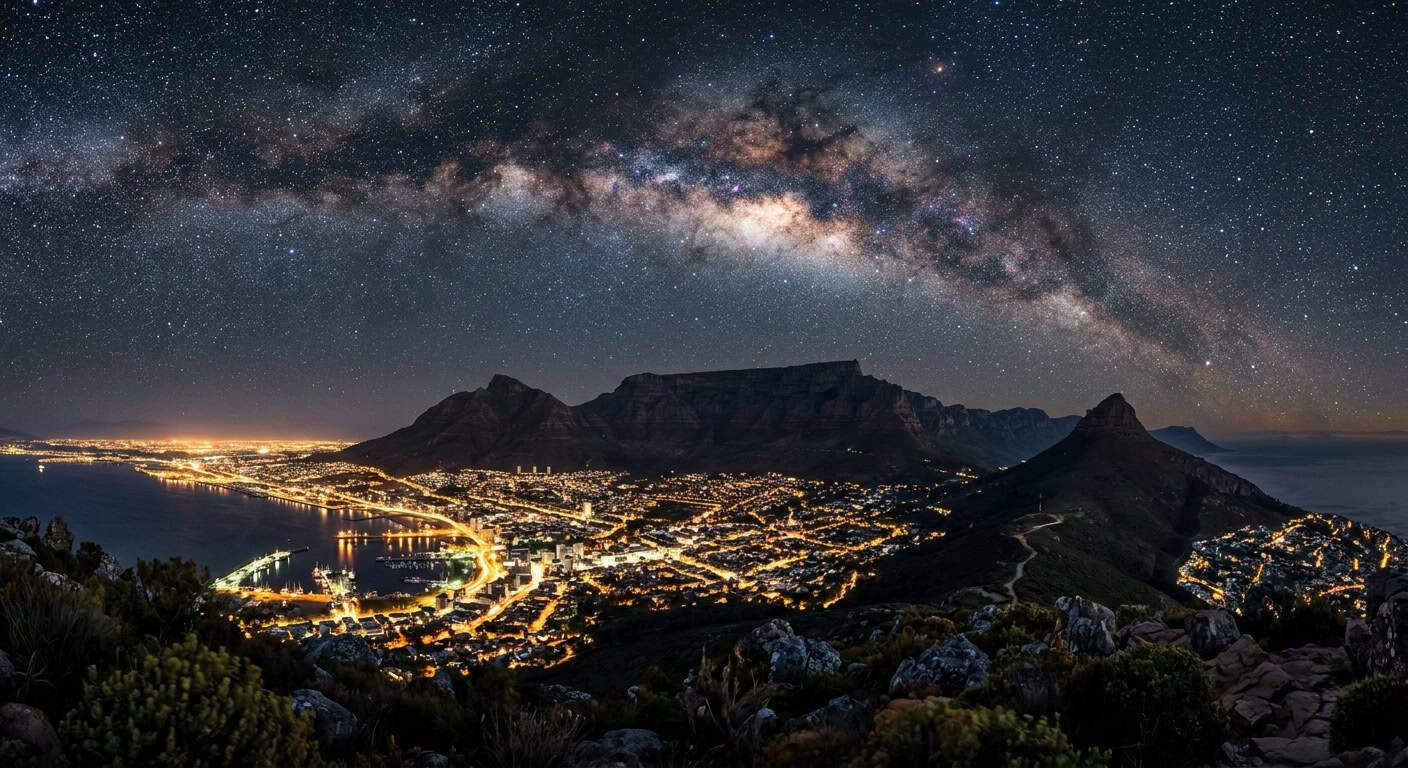
There is a specific kind of quiet that only exists under a truly dark sky. It’s not the absence of sound, but rather the presence of something so vast that it makes the hum of city life feel like a distant, slightly frantic memory. If you live in or around Cape Town, you know the struggle. We live in one of the most beautiful cities on Earth, but our bright lights—those glittering streetlamps and glowing skyscrapers—come with a trade-off. They act as a veil, hiding the most spectacular show in the Southern Hemisphere.
Have you ever looked up from your driveway and seen only a handful of lonely stars struggling against the orange glow of the suburbs? It’s a bit tragic when you realize that just a couple of hours away, the sky is thick with constellations, nebulae, and the swirling, smoky band of the Milky Way. Finding that darkness is like going on a treasure hunt. You have to drive past the last of the shopping malls, leave the highway behind, and wait for your eyes to adjust to the velvet blackness of the Cape’s wilder corners.
Whether you’re a serious amateur astronomer with a telescope in the trunk or someone who just wants to lie on a blanket and feel small for a while, there are a few places where the universe feels close enough to touch. Here is where I go when I need to reconnect with the stars.
The Historical Heart of South African Astronomy
You don’t actually have to leave the city limits to get a taste of the cosmos, provided you go to the right place. The South African Astronomical Observatory (SAAO) in Observatory is a sanctuary of science tucked away near the city center. It was established in 1820, making it the oldest permanent building in the Southern Suburbs.
What I love about this spot is the sense of history. Walking through the gates feels like stepping into a Victorian era of discovery. While the light pollution from the surrounding city means you won’t see the faint deep-sky objects you’d find in the desert, the “Open Nights” are a local institution. Usually held on the second and fourth Saturdays of the month, these evenings include a fascinating talk from a professional astronomer and a chance to look through the historic McClean telescope.
- The Experience: It’s a great entry point for families. You get to see the moon’s craters in startling detail or the rings of Saturn, which always look like a tiny, perfect sticker placed on the lens.
- The Grounds: The architecture is stunning, and the museum on-site houses artifacts that tell the story of how we first mapped the Southern skies.
- Booking: These nights are popular and usually free, but you absolutely have to book through their website in advance.
Key Takeaway: The SAAO is the best place for a “city-based” star fix, offering expert-led presentations and a chance to peer through world-class historical telescopes.
Mountain Magic at the Cederberg Observatory
If you are willing to drive about two and a half hours north of the city, you will find the gold standard of stargazing in the Western Cape. The Cederberg Observatory is located in the heart of the Cederberg Wilderness Area, a landscape of jagged orange rocks and ancient San rock art.
Because it’s shielded by the mountains and located far from any major town, the sky here is world-class. It’s the kind of darkness where the Milky Way actually casts a faint shadow on the ground. The observatory is run by a group of passionate volunteers who open the facility to the public most Saturday nights, provided the moon isn’t too bright.
I’ve spent many nights sitting on the benches there, listening to a volunteer point out the Southern Cross or the Magellanic Clouds with a high-powered green laser. It’s an informal, community-driven vibe that makes the complex science of the stars feel accessible and wonder-filled.
- Sanddrif and Kromrivier: Most people stay at the nearby farms like Sanddrif or Cederberg Park, which are just a short drive from the observatory.
- The Location: You can find the observatory via the Cederberg Wilderness Area.
- The “Full Moon” Rule: Keep in mind that the observatory usually closes on full moon weekends because the moon’s light is so bright it “washes out” the stars. Check their calendar before you make the trip.
Key Takeaway: For a truly immersive experience under some of the darkest skies in the country, the Cederberg is unbeatable. It combines rugged mountain beauty with an incredible community of amateur astronomers.
Stargazing Picnics on Paarl Mountain
For something a bit closer and more festive, the Afrikaanse Taalmonument in Paarl hosts regular stargazing picnics during the summer months. This is one of my favorite “date night” suggestions. You pack a picnic basket, grab some blankets, and head up the winding road of Paarl Mountain as the sun begins to set.
The view from the monument is spectacular even before the stars come out, with the lights of the Drakenstein Valley glowing below. Once darkness falls, the Orion Observation Group (OOG) sets up several large telescopes on the lawns. They usually focus the evening on a specific theme—like a particular planet that’s in opposition or a famous star cluster like the “Jewel Box.”
- Accessibility: It’s only about a 45-minute drive from Cape Town, making it a very easy Saturday night excursion.
- The Atmosphere: It’s very social. You’ll see families and groups of friends enjoying their dinner on the grass before queuing up for a look through the lenses.
- Safety: The monument grounds are secure and well-lit near the buildings, making it a safe and comfortable environment for an evening out.
Key Takeaway: The stargazing picnics in Paarl offer a perfect blend of a casual social outing and an educational look at the night sky through professional-grade telescopes.
The Ultimate Pilgrimage to Sutherland
I can’t write a guide to stargazing without mentioning the big one. Sutherland. It’s a four-hour drive into the Northern Cape, but for a star lover, it’s a journey to the center of the world. This tiny, freezing-cold Karoo town is home to the South African Astronomical Observatory’s Sutherland Station, which houses the Southern African Large Telescope (SALT).
SALT is the largest single optical telescope in the Southern Hemisphere. It’s so powerful that it can detect the light of a single candle on the moon. While you can’t look through the giant research telescopes yourself (they use digital sensors for science), the visitor center offers stargazing sessions using dedicated visitor telescopes that are still far more powerful than anything you’re likely to have at home.
- The Town: Sutherland is famous for being the coldest town in South Africa. Even in summer, the nights can be biting. In winter, snow is a regular occurrence. Pack every warm layer you own.
- Matjiesfontein: If you’re driving from Cape Town, I highly recommend stopping at the historic Lord Milner Hotel in Matjiesfontein for a drink or a night’s stay.
- The Location: The observatory plateau is located just outside the town of Sutherland.
Key Takeaway: Sutherland is the premier astronomical site in Africa. If you want to see the universe in its most raw and magnificent form, this is the pilgrimage you have to make.
Wilderness and Waves at West Coast National Park
If you prefer the sound of the ocean with your stars, the West Coast National Park is an underrated gem. Most people visit for the flowers in August, but the stargazing here throughout the year is phenomenal.
Because the park is a protected area, there is almost zero light pollution once you get away from the entrance gates. If you book one of the SANParks cottages inside the reserve—like the ones at Duinepos or the houseboats on the lagoon—you have the sky all to yourself. There is something profoundly moving about sitting on a deck, listening to the flamingos in the lagoon, and watching the Milky Way reflect in the still water.
- The “Wild” Feel: Unlike the organized observatory nights, this is a DIY experience. You’ll need to bring your own binoculars or just use your naked eye.
- Peace and Quiet: It’s one of the few places where you can enjoy the stars in total solitude, without any crowds or presentations.
Key Takeaway: For those who want to combine a weekend of birdwatching and coastal relaxation with some seriously dark skies, the West Coast National Park is a fantastic escape.
Pro Tips for the Aspiring Stargazer
- Check the Moon Phase: This is the most common mistake. For the best views of the Milky Way, aim for the “New Moon” phase or a few days before/after it.
- Use a Red Light: When you’re at a dark site, it takes your eyes about 20 minutes to fully adjust to the darkness. Use a red light (or put a piece of red cellophane over your torch) to preserve your night vision.
- Download a Star Map App: Apps like Stellarium or SkyGuide are incredible. You just point your phone at the sky, and they show you exactly what you’re looking at.
- Warmth is Key: Even in the middle of summer, standing still in the dark can get chilly very quickly. Always bring a jacket, a beanie, and maybe a thermos of coffee or tea.
- Patience: Your eyes see more the longer you look. Sit for ten minutes, let the stars “come out,” and you’ll be amazed at how much more detail you can perceive.
Why the Stars Matter
In our modern world, we spend so much time looking down at screens or straight ahead at the road. We forget that we are living on a tiny rock spinning through an almost incomprehensibly large universe. Stargazing is the ultimate perspective-shifter. It reminds us of the scale of things and the beauty of the natural world that exists far beyond our daily concerns.
Whether you’re standing in the historical shadow of the SAAO or shivering on the high plateau of Sutherland, looking up is an act of wonder. It’s a way to feel connected to the people who looked at these same stars thousands of years ago and to the explorers who will one day travel among them. So, the next time the city feels a bit too loud and the lights feel a bit too bright, grab a blanket, head for the mountains, and let the universe put on a show for you.