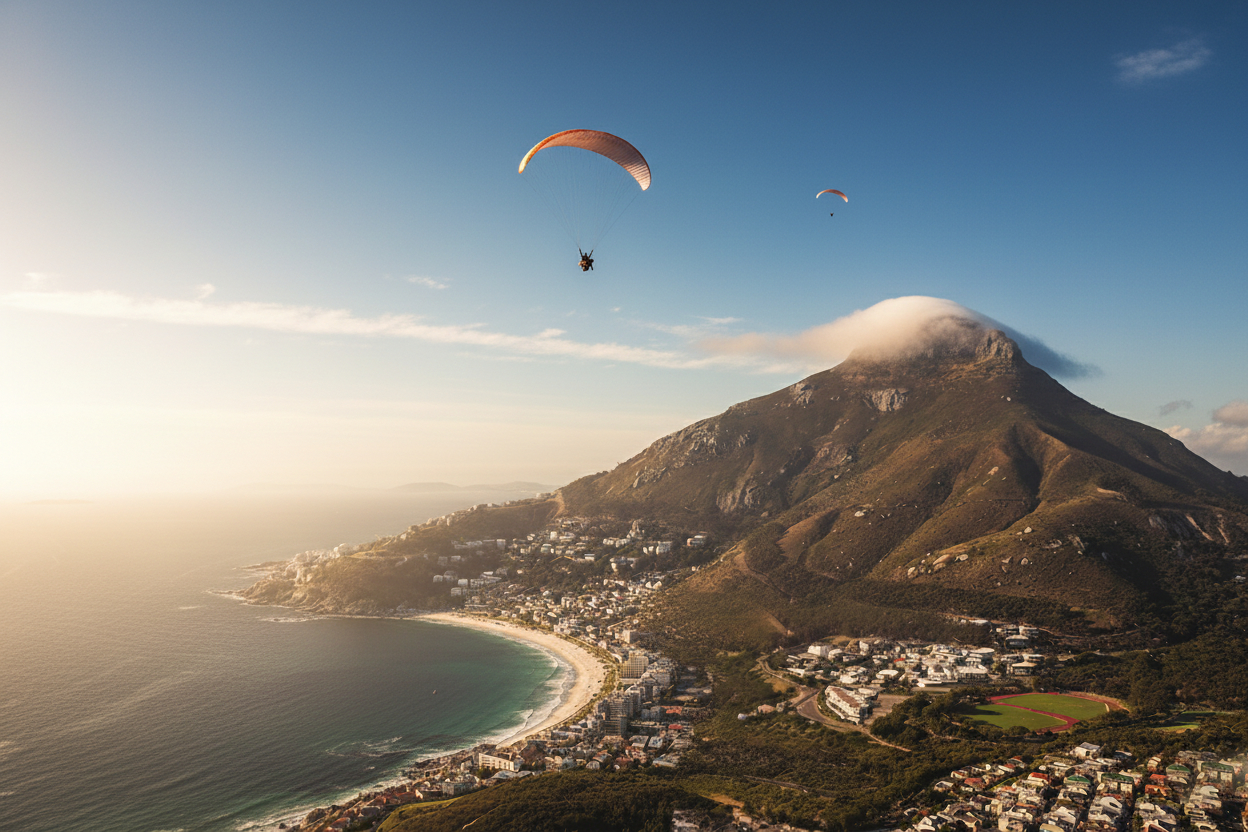
If you’ve ever spent a Saturday afternoon strolling along the Sea Point Promenade, you’ve definitely done the “Cape Town Cranes” move. It’s that involuntary action where you stop, tilt your head back, and squint at the colorful, jellyfish-like canopies drifting silently toward the grassy landing strip near the lighthouse.
From the ground, it looks serene. Peaceful. Almost like a slow-motion ballet against the backdrop of Lion’s Head. But if you’re anything like me, your second thought is usually a mix of curiosity and sheer terror. Is it actually as calm as it looks, or is the person up there currently reconsidering every life choice they’ve ever made?
In a city that offers everything from world-class dining to rugged mountain peaks, taking a tandem flight from Signal Hill is often at the top of the “must-do” list. But is it worth the adrenaline spike? Let’s strip away the fluff and look at the reality of dangling from a piece of fabric over the Atlantic.
The Moment of Truth: What It Actually Feels Like
The biggest misconception about paragliding is that it feels like a rollercoaster. You know that “stomach-drop” sensation you get on a steep fall? Surprisingly, that doesn’t happen here. Paragliding is more about lift than it is about falling.
The Takeoff: The “Run-Run-Run” Ritual
When you arrive at the launch site, you aren’t jumping off a cliff. There is no “leap of faith” involved. Instead, you are strapped into a harness that eventually feels like a very comfortable lounge chair. Your pilot waits for a specific breath of wind—a gentle puff from the ocean—and then yells, “Run!”
You scramble forward, feeling a massive tug on your shoulders as the wing inflates behind you. You keep running even when you feel like you’re fighting a giant invisible hand. Then, suddenly, your feet are kicking at thin air. There is no jolt. You just… stop being on the ground.
The Sound of Silence
Once you’re airborne, the first thing that hits you is the silence. Most of our high-altitude experiences involve the roar of a plane engine or the hum of the Table Mountain cable car. Here, there is only the whistling of the wind in the lines and the occasional “beep-beep” of the pilot’s variometer.
It’s an incredibly visceral sensation. You feel the temperature drop as you gain height. You feel the “thermals”—warm bubbles of air rising from the sun-baked rocks—lifting you higher. It’s the closest a human can get to actually feeling how a bird navigates the sky.
Key Takeaway: Paragliding is a sensory experience of “floating” rather than “falling.” If you’re looking for high-speed G-forces, this isn’t it. If you’re looking for a transcendental sense of space, this is exactly it.
The Logistics of the Leap: Who Keeps You Safe?
Because this is a tandem experience, you are essentially a passenger on a very high-altitude taxi. You don’t need any training, but you do need to trust your pilot. The companies operating out of Signal Hill are some of the most experienced in the world, largely because Cape Town’s erratic wind conditions turn pilots into absolute masters of their craft.
The Veteran Operators
- Fly Cape Town Paragliding: A team of veterans who prioritize smooth, long-duration flights when the conditions allow.
- Para Taxi: They have a heavy emphasis on storytelling and making the passenger feel completely at ease before the feet even leave the ground.
- Cape Town Tandem Paragliding: Their focus on high-quality media means you’ll have great footage to prove you actually did it.
The Weather Factor
This is the one “un-fun” part of the experience: the uncertainty. Paragliding is 100% at the mercy of the wind. If the South Easter is pumping too hard or the “Tablecloth” cloud is rolling over the mountain, you aren’t going anywhere.
Pro Tip: Always book your flight for the first available morning of your trip. If the wind is wrong, you’ll want those extra days to reschedule. Don’t wait for your final afternoon, or you’ll likely leave the city without ever getting off the ground.
Comparing Views: Why This Beats the Cable Car
We’ve all been up the cable car. It’s iconic. But the view from a paraglider is fundamentally different.
- 360-Degree Unobstructed Vision: There is no glass between you and the horizon. You can look straight down between your boots at the multi-million-rand villas of Clifton or look horizontally at the jagged peaks of the Twelve Apostles.
- The Perspective of Scale: From a paraglider, you realize how narrow the strip of land is between the mountains and the sea. You see the layout of the Green Point Urban Park like it’s a tiny architectural model.
- Active Participation: You aren’t just a spectator. Many pilots will let you take the toggles for a few seconds once you’re at a safe altitude, giving you a taste of how the wing actually steers.
Bold Takeaway: If the cable car is a movie, paragliding is a VR experience. One is something you see; the other is something you are inside of.
Is It Actually Scary? (The Nitty-Gritty on Nerves)
Let’s be honest: your brain is designed to tell you that being 2,000 feet in the air without a cockpit is a bad idea. Fear is part of the package.
However, most people find that the “fear” is concentrated in the 15 minutes of preparation on the hill. Once you are in the air and you realize the harness is secure and the movement is steady, the adrenaline usually shifts into a state of “flow.”
- For the Nauseous: If you get motion sickness easily, tell your pilot immediately. They can avoid the “spiral” maneuvers at the end (which are fun for some but a nightmare for others) and keep the flight path as straight and stable as possible.
- For the Acrophobic: Interestingly, many people with a fear of heights find paragliding okay because there isn’t a fixed “drop” beneath them (like a ladder or a balcony). The sheer scale of the landscape makes the height feel more abstract and less threatening.
Post-Flight: The Best Places to Decompress
Once you land on the Sea Point Promenade, your adrenaline will be at an all-time high. You’ll have “the wobbles”—that strange sensation of your legs trying to remember how to walk on solid ground. You’re going to need a place to sit, grab a drink, and look back up at the hill you just conquered.
1. Strolla
Located just a short walk from the landing site, Strolla is the unofficial “post-flight” headquarters. It’s breezy, casual, and perfect for a celebratory coffee or a local craft beer.
- The Vibe: Coastal chic with plenty of outdoor seating to watch other gliders come in for a landing.
2. The Creamery
If you’ve just survived a brush with the sky, you deserve ice cream. The Creamery in Mouille Point serves what most locals consider the best handmade ice cream in the city.
- The Order: Sea Salt Caramel or whatever their seasonal fruit flavor is this month.
3. Scheckter’s Raw
If your adrenaline has left you feeling like you need a “health kick” to ground yourself, Scheckter’s Raw in Sea Point is the place for a nutrient-dense smoothie or a vegan burger that actually tastes like a celebration.
Practical Tips for First-Time Flyers
- What to Wear: Even on a blistering Cape Town summer day, it is cold at 2,000 feet. Wear a windbreaker or a light fleece. Closed shoes are mandatory. If you wear flip-flops, they will fall off during takeoff and become a permanent gift to the residents of Fresnaye.
- The “Weight” Rule: There are weight limits (usually between 20kg and 120kg) for safety reasons regarding the wing’s glide ratio. If you’re on the edge of these, check with the operator beforehand.
- GoPro or No-Pro? Most companies offer a media package. While it’s tempting to try and film it on your own phone, don’t. You’ll spend the whole flight looking at your screen rather than the horizon, and there is a high chance you’ll drop your phone. Let the pilot handle the GoPro so you can actually experience the flight.
The Verdict: Is It Worth It?
If you measure “worth” by the longevity of a memory, then paragliding is one of the highest-value things you can do in South Africa.
We spend so much of our time in Cape Town looking at the mountain or looking down from the mountain. Paragliding is the only time you get to feel like you are part of the mountain’s ecosystem. It’s a moment of total presence. You aren’t thinking about your emails or your chores; you are thinking about the wind, the wing, and the impossible blue of the Atlantic.
Key Takeaway: You aren’t paying for a ride; you’re paying for the story you’ll tell for the next twenty years. In the hierarchy of Cape Town experiences, this is the one that truly changes your perspective of the city.
Whether you’re a seasoned thrill-seeker or someone looking to push their boundaries just once, the view from the harness is something everyone should see at least once. Just remember to keep running until your feet leave the earth.