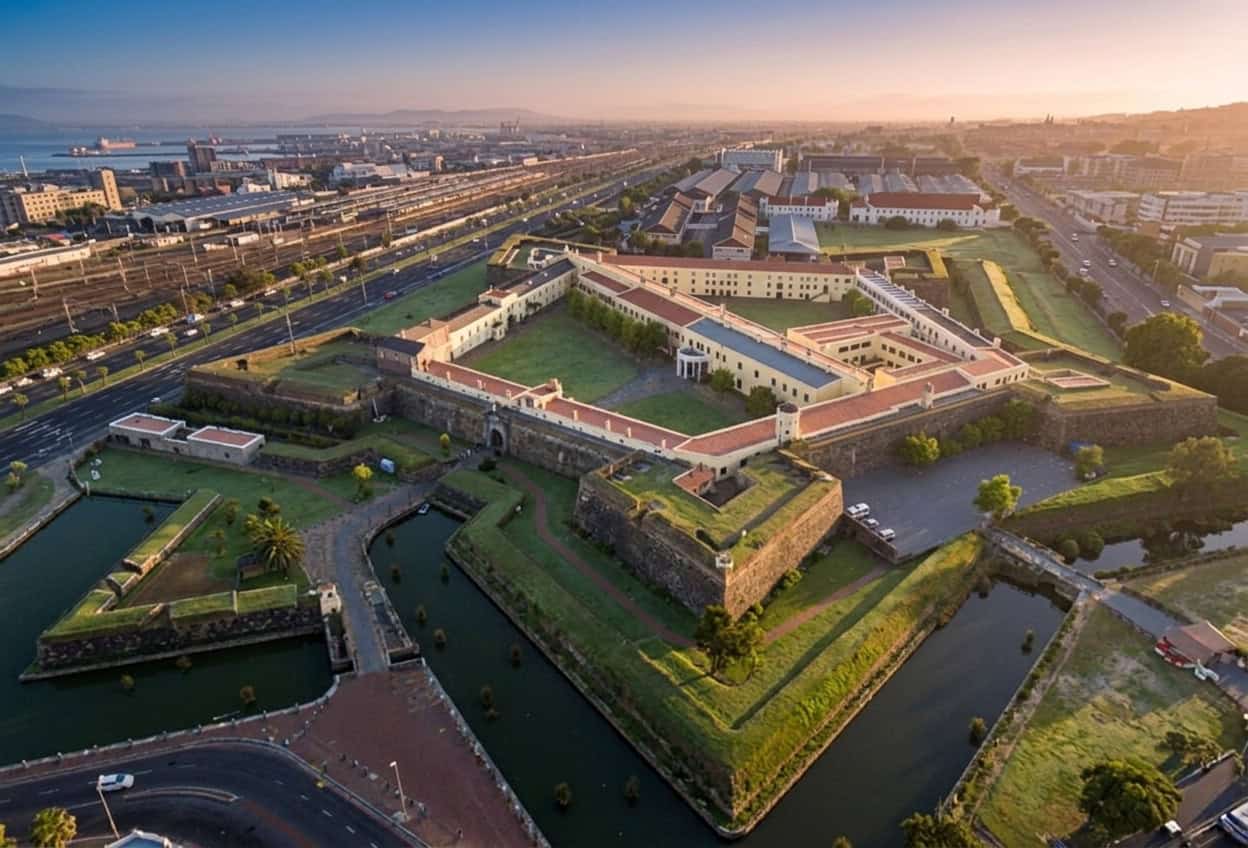
If you’ve ever found yourself stuck in the midday traffic on Darling Street, you’ve probably glanced over at those massive, sun-baked yellow walls and wondered, “What actually happens in there?” It’s a fair question. To the casual observer, the Castle of Good Hope looks like a silent, stone giant watching over the chaos of the Golden Acre bus terminus and the hustle of the Grand Parade.
But here’s the thing: I’ve lived in Cape Town for a long time, and I’ve learned that the Castle is one of the few places in the city where the air feels genuinely heavy with history. It’s not just a collection of old rocks; it’s a pentagonal portal to 1666. It’s the oldest colonial building in South Africa as it undergoes a massive, multi-million rand restoration, it’s also a site of a fascinating “decolonial” makeover.
Whether you’re a history buff, a photography nerd, or just looking for a way to kill two hours between museum visits, the Castle is far more than just a fortress. It’s a story of survival, pain, and eventual reclamation. Let’s dive into how to navigate this 360-year-old star.
1. The Architecture of Survival: Why a Pentagon?
When the Dutch East India Company (VOC) decided to build this place, they weren’t looking to make a style statement. They were scared. The English were breathing down their necks, and they needed a fortification that could provide defensive fire in every single direction.
The Five Bastions
The Castle is built in the shape of a five-pointed star. Each of the bastions was named after the titles of the Prince of Orange:
- Leerdam: The western bastion.
- Buuren: The northern bastion.
- Katzenellenbogen: The eastern bastion (and my personal favorite to try and pronounce).
- Nassau: The southern bastion.
- Oranje: The south-western bastion.
What’s wild about standing on top of these ramparts is seeing how much the city has grown around them. When the Castle was first finished in 1679, the waves of Table Bay literally lapped against the walls of the Buuren bastion. Today, thanks to land reclamation, the sea is nearly two kilometers away.
Key Takeaway: Walk the perimeter of the ramparts first. You get a unique view of the city skyline and Table Mountain that you won’t find anywhere else.
2. The Daily Rituals: Cannons and Keys
If you like a bit of theater with your history, you need to time your visit correctly. The Castle isn’t a static museum; it’s a functioning military site.
The Key Ceremony (Monday to Friday, 10:00 & 12:00)
This is a ritual that has been performed for centuries. A ceremonial guard, dressed in traditional uniform, marches to the main gate to “unlock” the fortress. It’s a small, rhythmic piece of history that makes you realize how much the world has changed while these gates have stayed the same.
The Signal Cannon (Monday to Saturday, times vary)
You haven’t truly experienced the Castle until you’ve jumped out of your skin when the signal cannon goes off. Usually fired at 10:00, 11:00, or 12:00 (check the board at the entrance as times can shift), it’s a deafening reminder of how the city used to keep time.
- Note: The firings are still weather-dependent. If it’s a particularly gusty South Easterly, they might skip the blast for safety reasons.
3. The Art and the Artifacts: The William Fehr Collection
Once you’ve explored the outside, head into the Iziko William Fehr Collection. This is where the Castle hides its “indoor” treasures.
William Fehr was a businessman who spent his life collecting Cape art, furniture, and ceramics. The collection is housed in the “Kat” balcony building—the grand structure with the ornate gables that divides the inner courtyard.
- The Paintings: You’ll see oil paintings of the Cape as it looked in the 1700s. It’s haunting to see a painting of a lush, green valley and realize it’s now the location of a shopping mall.
- The Furniture: Look for the massive stinkwood and yellowwood armoires. These pieces were built to survive the humid Cape winters and the dry summers, and they are masterpieces of colonial craftsmanship.
- The Ceramics: There is a permanent exhibition called FIRED, which showcases the incredible history of pottery and ceramics at the Cape, from indigenous clay pots to imported Chinese porcelain.
Key Takeaway: The William Fehr Collection offers the “civilized” side of the Castle’s history, providing a stark contrast to the grit of the military barracks.
4. The Donker Gat: Facing the Darker History
I’ll be honest: the Castle isn’t all grand balconies and pretty paintings. For much of its history, it was a place of exclusion, slavery, and torture. To truly understand the Castle, you have to go downstairs.
The Dungeons
The Donker Gat (Dark Hole) is exactly what it sounds like. It was the Castle’s dungeon—a series of cold, damp rooms where prisoners were kept in total darkness. Even today, with the lights on, it feels claustrophobic. You can still see names and dates scratched into the wood of the doors by people who were held here hundreds of years ago.
The Decolonial Shift
Tthe management of the Castle has made a massive effort to tell the whole story. It’s no longer just about the Dutch governors.
- You’ll find a memorial to Krotoa, a Khoi woman who played a pivotal role as a translator and diplomat between the Dutch and the local tribes.
- The exhibitions now highlight the lives of the enslaved people who actually built the walls you’re standing on.
Bold Takeaway: The Castle is transitioning from a symbol of colonial oppression into a site of healing and dialogue. Don’t skip the “controversial” bits; they are the most important parts of the tour.
5. The Makeover: What’s New?
If you visit you’ll notice some scaffolding. Don’t let that put you off. The Castle is currently undergoing its biggest restoration in 20 years—an R84 million project.
- The Yellow Walls: They are being repainted in the original “ochre” yellow. It’s a specific pigment that was chosen historically to hide the dust and grime of the 17th-century streets.
- The Dolphin Pool: The historic pool where Lady Anne Barnard (a famous Cape socialite) allegedly bathed in the nude is being refurbished. It’s a beautiful, quiet spot that feels miles away from the city.
- Accessibility: For the first time, elevators are being installed in key areas to make the museum more accessible to the elderly and disabled—a huge win for a building that was designed to keep people out!
6. Practical Tips for the Savvy Traveler
The Castle is a bit of a maze, so here’s how to handle it like a pro:
- Parking: Don’t try to find street parking. It’s a nightmare. Park at the Castle of Good Hope Parking Lot directly across from the entrance. It’s secure and reasonably priced.
- Footwear: Wear flat shoes. The cobblestones are original, which means they are uneven, slippery when wet, and absolutely lethal for high heels.
- Tickets: You can buy them at the gate, but I always recommend booking a guided tour (usually at 11:00, 12:00, or 14:00) to get the best stories.
- The Gift Shop: It’s actually one of the best in the city. They focus on local crafters and small businesses rather than mass-produced souvenirs.
Where to Head Next
Once the cannons have stopped firing and you’ve walked the ramparts, you’re ideally placed to explore the rest of the CBD.
If you need a coffee to process the history, walk five minutes to Truth Coffee Roasting, or if you’re feeling hungry, head over to the Company’s Garden for a sandwich under the trees.
The Castle of Good Hope isn’t just a museum; it’s a living, breathing testament to the layers of Cape Town. It’s where the city began, where it suffered, and where it’s now trying to find a new identity. It’s a bit rough around the edges, a little bit haunted, and entirely essential.