If you’re planning a trip to the Cape Winelands and your first instinct is to book a massive, five-star resort with three hundred rooms and a sprawling lobby, you’re likely about to miss the entire point of being there. Big hotels, for all their efficiency and brand-standard amenities, tend to act as a barrier between you and the landscape. They offer a sterilized version of the Cape. If you want to actually feel the rhythm of a working farm or understand why the “Boland” is considered the spiritual heart of South African hospitality, you have to go smaller. You have to find the guest houses that feel like they were built by people who actually live there, rather than designed by a corporate committee in a different time zone.
In South Africa, the “Guest House” label is a bit of a misnomer for the high-end market. We aren’t talking about a spare bedroom in someone’s suburban home with a dusty doily and a communal kettle. We are talking about architectural masterpieces, restored 17th-century manor houses, and minimalist glass boxes perched on the edge of cliffs. These are places where “luxury” is measured in the silence of the morning and the quality of the olive oil produced fifty meters from your doorstep. Here is my unfiltered guide to the stays that offer something genuinely different from the standard tourist loop.
The Regenerative Magic of Sterrekopje Farm
Most people head to Franschhoek for the restaurants, but if you want to understand the modern evolution of the Winelands, you head to Sterrekopje Farm. This isn’t just a place to sleep; it’s a high-end “regenerative” farm that feels like it’s operating on a different frequency. When you arrive, the focus isn’t on a formal check-in desk, but on the garden. Everything here is built around the idea of a “Sanctuary,” but without the pretense of a typical wellness retreat.
What makes Sterrekopje unique is the raw, tactile nature of the luxury. You’ll find handmade ceramics, tapestries, and a library that feels like it was curated by a world traveler who actually read the books. The rooms are scattered across a farm that produces its own honey, flour, and medicinal herbs. I’ve found that the best way to experience it is to lean into their “unstructured” philosophy. You might spend an afternoon helping the bakers in the wood-fired oven or wandering through the orchards. It is one of the few places in the world that manages to feel incredibly expensive while being completely unpretentious.
Sterrekopje Farm is the ultimate choice for those who want a deeply restorative, farm-to-table experience that prioritizes soul over status.
High Altitude Solitude at 7 Koppies
If your priority is views that make you feel like you’re the only person left on earth, 7 Koppies is the place to book. Perched high on a ridge in the Franschhoek valley, it sits within 50 hectares of pristine fynbos. The name refers to the seven small hills that define the topography of the estate, and the guest house itself is a masterclass in eclectic, understated style.
The main house feels like a private residence—largely because it often is one. The owners have filled it with an incredible mix of South African art and vintage furniture. Because of its elevation, the air here feels different—cooler, crisper, and scented with the wild buch of the mountain. You’re only a ten-minute drive from the center of Franschhoek, but standing on their terrace looking down at the valley, you feel a thousand miles away.
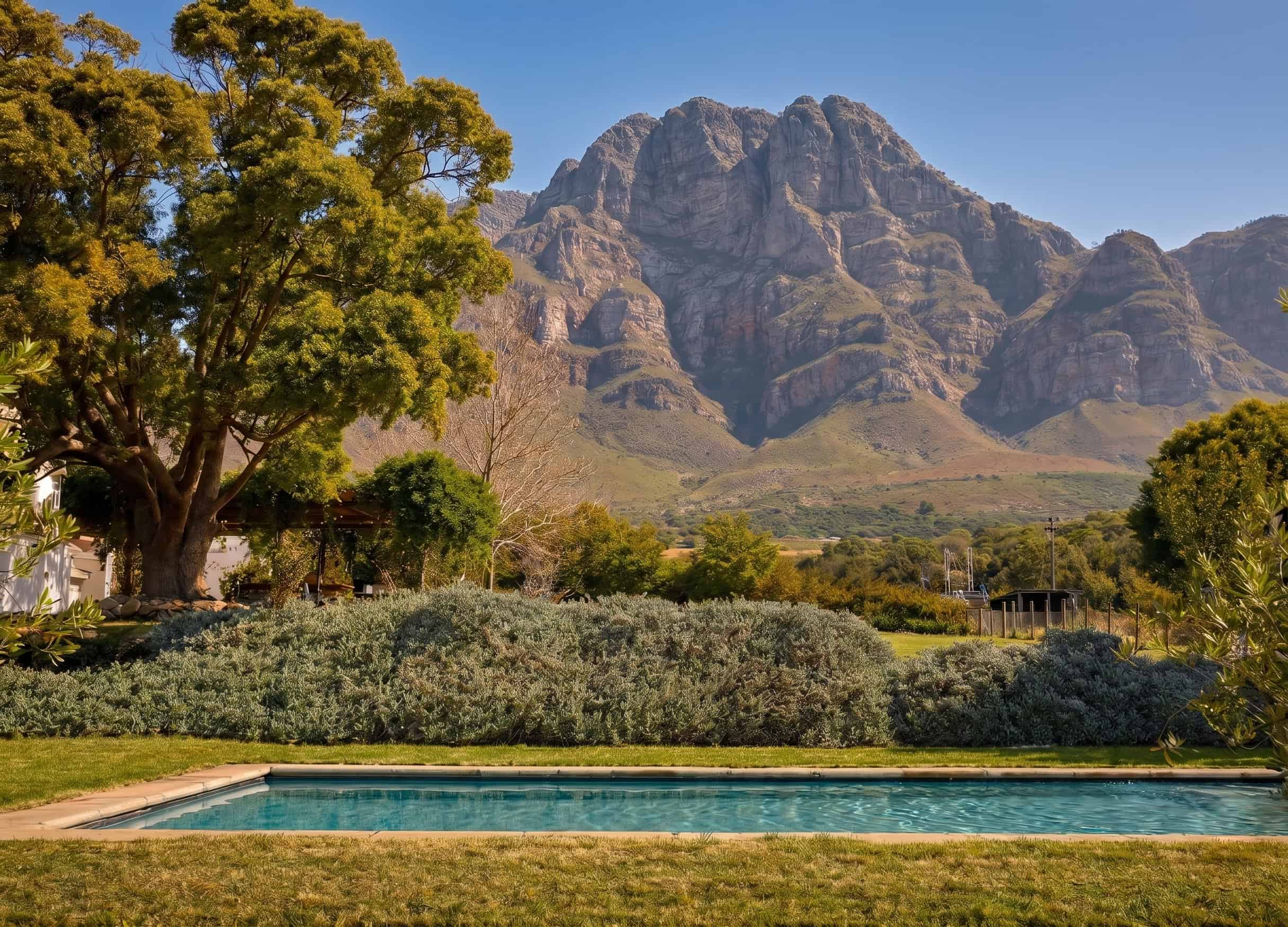
One of the most striking features is the 25-meter lap pool that seems to hang off the edge of the hill. It’s the kind of place where you don’t feel the need to leave. My advice is to clear your schedule of “wine tours” for at least one day and just watch the light move across the mountains. It is a rare experience of pure, unadulterated space.
7 Koppies offers an exclusive, high-altitude retreat that feels like a private villa, perfect for those seeking architectural beauty and total privacy.
Contemporary Design and Banhoek Views at De Zeven
Tucked into the Banhoek Valley between Stellenbosch and Franschhoek is De Zeven. While many Winelands stays lean heavily into the “Cape Dutch” aesthetic with gables and antiques, De Zeven goes in the opposite direction. It is a sleek, modern structure of wood, stone, and glass that is designed specifically to frame the Banhoek Valley.
The central living area is a massive, double-volume space with a fireplace that could probably heat a small village. What I appreciate most about De Zeven is how it handles the landscape. The mountains in the Banhoek Valley are particularly jagged and dramatic, and the guest house uses massive floor-to-ceiling windows to make them part of the room.
It’s an active person’s guest house. You are surrounded by some of the best hiking and mountain biking trails in the country. You can spend the morning working up a sweat on the slopes and the afternoon in their pool, which offers one of the most unobstructed views of the Drakenstein mountains you’ll find anywhere. It’s also perfectly positioned for visiting some of the more “serious” wine estates like Oldenburg or Bartinney.
De Zeven is a modern architectural gem that provides the best access to the Banhoek Valley’s rugged mountain trails and premier wine estates.
The Private Village Vibe of La Clé
If you’ve ever fantasized about actually living in Franschhoek, La Clé is as close as you’re going to get. This isn’t a single building but a collection of distinct houses and lodges scattered near the village center. You can book a single room in “The Lodge” or take over an entire manor house for a group of friends.
The interior design here is exceptionally clever. It’s “village chic”—comfortable, colorful, and very high-end without being stiff. What makes La Clé unique is the sense of belonging. Because the properties are integrated into the edges of the town, you feel like a local resident rather than a tourist in a bubble. The “Table d’Hôte” style dining, where guests eat together at a long table, creates a communal atmosphere that you simply won’t find in a traditional hotel.
I’ve always found that the staff at La Clé operate more like family friends. They’ll point you toward the bakery that only the locals use or find you a table at a restaurant that claims to be fully booked. It’s that level of “insider” knowledge that makes a boutique stay so much more valuable than a resort.
La Clé provides a stylish, communal “home away from home” experience that integrates you perfectly into the village life of Franschhoek.
Practical Logistics for Your Winelands Escape
Staying at these kinds of guest houses requires a slightly different approach than a standard hotel stay. Because they are smaller and more intimate, you need to be a bit more proactive about your logistics.
- The Wine Tram: If you’re staying in Franschhoek, the Franschhoek Wine Tram is a fun novelty, but it can be quite “touristy.” For these more exclusive guest houses, I usually recommend arranging a private driver through the host. It allows you to visit the smaller, boutique estates that the tram doesn’t reach.
- Booking Your Meals: The Winelands is a culinary heavyweight. Restaurants like La Petite Colombe or The Fat Cactus (for something laid back) fill up weeks in advance. Don’t wait until you arrive to ask the guest house for a booking.
- The Wind and the Sun: The valley floor can get incredibly hot in summer. If you’re planning on [suspicious link removed], start at daybreak. Conversely, the evening wind (the South Easter) can be brisk, so always have a light jacket handy even if it was 35 degrees at noon.
- Direct Interaction: Use the guest house hosts. These people are usually deep-rooted in the community. If you want a private tasting with a winemaker or access to a closed gallery, they are the ones who can make the phone call.
Why the Boutique Choice Wins Every Time
At the end of the day, you aren’t flying half-way across the world to sit in a room that looks like it could be in London or New York. You’re there for the red dust of the farm roads, the sound of the wind in the ancient oaks, and the specific taste of a wine made from the soil right beneath your feet.
The big resorts can give you a comfortable bed and a reliable breakfast, but these unique guest houses give you a story. They give you a connection to the place that outlasts your tan and your wine haul. They remind us that the best travel experiences aren’t about being pampered in a vacuum; they’re about being a guest in a home that someone has built with passion and history.